Books For Kids: Christmas

Red and Lulu

By Matt Tavares

Red and Lulu make their nest in a particularly beautiful evergreen tree. It shades them in the hot months and keeps them cozy in the cold months. Once a year the people who live nearby string lights on the tree and sing: O Christmas Tree, O Christmas Tree. But one day, something unthinkable happens, and Red and Lulu are separated. It will take a miracle for them to find each other again. Fortunately, it’s the season for miracles. 3-7 years
Christmas From Heaven: The True Story of the Berlin Candy Bombers

By Tom Brokaw, Illustrated by Robert T. Barrett

This is the story of the humble beginnings of what became a beacon of hope to a war-torn country. Gail Halvorsen, a young pilot in the U.S. Army Air Corps was assigned as a cargo pilot to the Berlin Airlift, in which U.S. forces flew much needed supplies into Soviet-blockaded Berlin. Lt. Halvorsen offers gum to the German children gathered outside the Tempelhof Air Base. He knows they have very little and decides he will bomb Berlin with candy. 5 and up
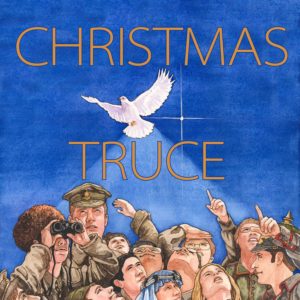
The Christmas Truce: A True Story of World War I

By Aaron Shepard

Christmas Day, 1914, My dear sister Janet, It is 2:00 in the morning and most of our men are asleep in their dugouts — yet I could not sleep myself before writing to you of the wonderful events of Christmas Eve. In truth, what happened seems almost like a fairy tale, and if I hadn’t been through it myself, I would scarce believe it. Just imagine: While you and the family sang carols before the fire there in London, I did the same with enemy soldiers here on the battlefields of France! 9-12 years
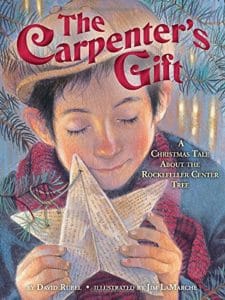
The Carpenter’s Gift: A Christmas Tale About the Rockefeller Center Tree

By David Rubel, Illustrated by Jim LaMarche

The story opens in Depression-era New York City. Eight-year-old Henry and his father are selling Christmas trees. They give a tree to the construction workers building Rockefeller Center. Through the kindness of the construction workers and neighbors, Henry gets his wish for a home to replace his family’s shack. He plants a pinecone from the first Rockefeller Center Christmas tree. It becomes a Christmas tree for Rockefeller Center when Henry is an old man. After Christmas, the tree’s wood is used to build a home for a family in need. 5-9 years
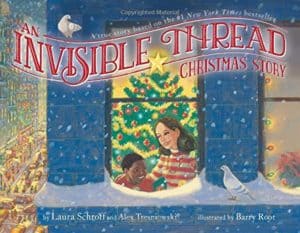
An Invisible Thread Christmas Story

By Laura Schroff and Alex Tresniowski

Illustrated by Barry Root

Laura Schroff tells the story of the first Christmas that she and Maurice, a boy she met on the street asking for change, spent together. She shares how Maurice gave her a small white bear, and as she later learns, the one thing he had that he could truly call his own, to show her how grateful he was for their friendship. 4-8 years
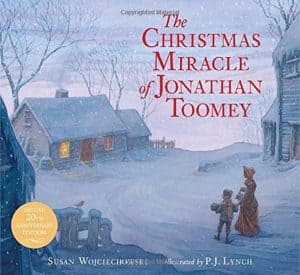
The Christmas Miracle of Jonathan Toomey

By Susan Wojciechowki, Illustrated by P.J. Lynch

Jonathan Toomey is the best woodcarver in the valley, but he is always alone and never smiles. No one knows about the mementos of his lost wife and child that he keeps in an unopened drawer. But one early winter’s day, a widow and her young son approach him with a gentle request that leads to a joyful miracle. 6-9 years
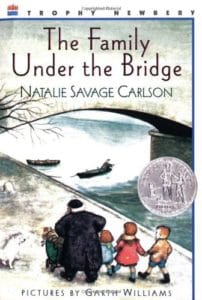
The Family Under the Bridge

By Natalie Savage Carlson

Armand, an old Parisian living on the streets of Paris, relishes his solitary life. He begged and did odd jobs for money to keep himself warm and fed, and he liked his carefree life. Then one day just before Christmas, a struggling mother and her three children walked into his life. Though he tried to ignore their troubles, Armand soon found himself caring for the family and sharing his unusual home with them. It did not take Armand very long to realize that he had a ready-made family; one that he loved with all his heart, and one for whom he would have to find a better home than under the bridge.  8-12 years
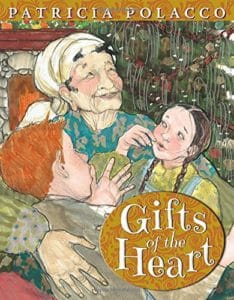
Gifts of the Heart

By Patricia Polacco

Richie and Trisha want to buy Christmas gifts for their family, but they don’t have enough money. Enter Kay Lamity, a new housekeeper…but is that all she is? She comes into their lives like a whirlwind, brimming with positive energy and a can-do attitude. Kay not only straightens them out when it comes to whether or not Santa Claus is real, she teaches them something about gifts: the just-good-enough kind that come from the pocketbook and the unforgettable kind that come from the heart. Because of Kay, Trisha and Richie and their family have a Christmas morning they will never forget. 5-8 years

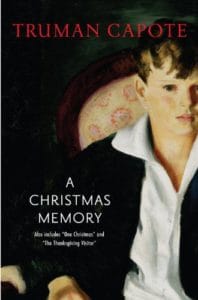
My favorite Christmas book, A Christmas Memory, by Truman Capote. A beautiful book to share with children.
For some holiday fun, desserts paired with classic Christmas books at: https://www.berries.com/blog/desserts-and-classic-christmas-books

The book descriptions used are primarily from the publishers.

If you like this post, then please consider sharing it and leaving a comment below. Thank you! Barbara Lowell, Children’s Author

Books For Kids: Hanukkah

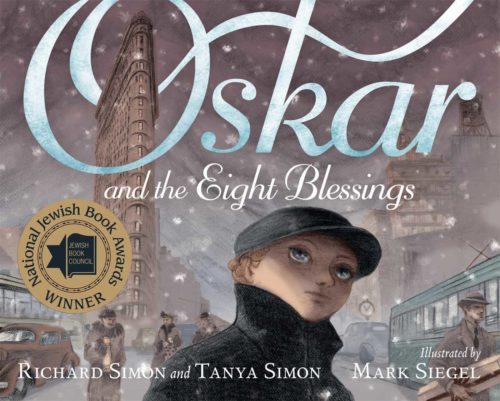
Oskar and the Eight Blessings

By Tanya Simon and Richard Simon

Illustrated by Mark Siegel

Oskar, a refugee seeking sanctuary from the horrors of Kristallnacht arrives by ship in New York City. He has only a photograph and an address for an aunt he has never met. It is both the seventh day of Hanukkah and Christmas Eve, 1938. As Oskar walks the length of Manhattan, from the Battery to his new home in the north of the city, he experiences the city’s many holiday sights. He meets its various residents. Each offers Oskar a small act of kindness, welcoming him to the city and helping him on his way to a new life. 4-8 years

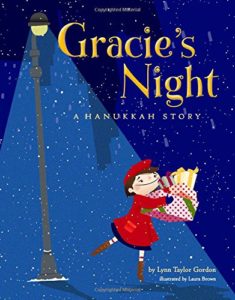
Gracie’s Night: A Hanukkah Story

By Lynn Taylor Gordon, Illustrated by Laurie Brown

There’s lots of love in Gracie’s and Papa’s lives, but not much money. Gracie finds a resourceful way to buy Papa some well-deserved Hanukkah gifts. But an encounter on a bitterly cold night opens her eyes and alters her plans. When we are brave enough to reach out instead of looking away, each of us can bring someone a miracle. 4-8 years

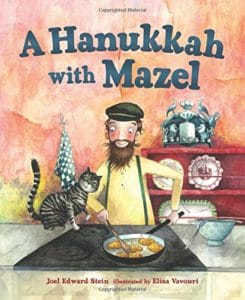
A Hanukkah with Mazel

By Joel Edward Stein, Illustrated by Elisa Vavouri

Misha, a poor artist, has no one to celebrate Hanukkah with until he discovers a hungry cat in his barn. The lucky little cat, whom Misha names Mazel, inspires him to turn each night of Hanukkah into something special. He doesn’t have money for Hanukkah candles, but he can use his artistic skills to bring light to his home as Mazel brings good luck to his life. 3-8 years

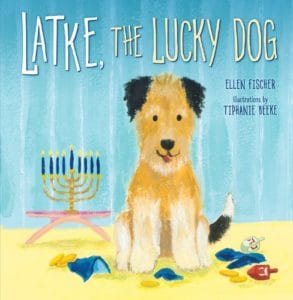
Latke, the Lucky Dog

By Ellen Fisher, Illustrated by Tiphanie Beeke

Rescued from an animal shelter on the first night of Hanukkah, Latke the puppy joins the family just in time for the celebrations. Although he has trouble learning the house rules, he is one lucky dog. 5-7 years

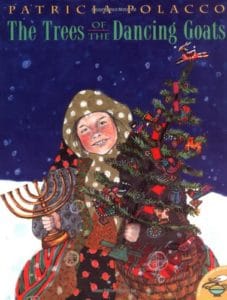
The Trees of the Dancing Goats

By Patricia Polacco

Trisha loves the eight days of Hanukkah. Her mother stays home from work, her Babushka makes delicious potato latkes, and her Grampa carves wonderful animals out of wood as gifts for Trisha and her brother. In the middle of her family’s preparations for the festival of lights, Trisha visits her closest neighbors, expecting to find them decorating their house for Christmas. Instead they are all bedridden with scarlet fever. Trisha’s family is one of the few who has been spared from the epidemic. Grampa has an inspiration: they will cut down trees, decorate them, and secretly deliver them to the neighbors. “But what can we decorate then with?” Babushka asks. Although it is a sacrifice, Trisha realizes that Grampa’s carved animals are the perfect answer. 5-8 years

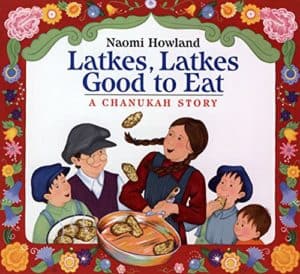
Latkes, Latkes, Good to Eat: A Chanukah Story

By Naomi Howland

Sadie and her four little brothers are very poor and always hungry. On the first night of Chanukah, Sadie performs a generous act, and in turn receives a frying pan that cooks up sizzling hot, golden latkes on command. Sadie tells her brothers never to use the magic pan, but when she goes out one afternoon, the mischievous boys can’t resist. They remember the words to start the pan cooking, but what were the words to make it stop? 4-7 years

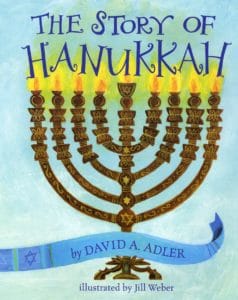
The Story of Hanukkah

by David A. Adler, Illustrated by Jill Weber

No celebration of Hanukkah would be complete without recounting the events of more than two thousand years ago that the holiday commemorates. In a simple yet dramatic text and vibrant paintings, the story of the courageous Maccabees and the miracle that took place in the Temple in Jerusalem is retold. 5-8 years

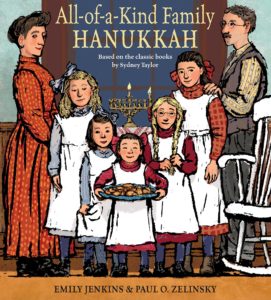
All-of-a-Kind Family Hanukkah

By Emily Jenkins, Illustrated by Paul O. Zelinsky

Emily Jenkins and Paul O. Zelinsky bring the beloved All-of-a-Kind Family to life in a new format. Fans along with those just meeting the five girls (“all of a kind,” as their parents say,) will join them back in 1912, on the Lower East Side of New York City, and watch as preparations for Hanukkah are made. When Gertie, the youngest, is not allowed to help prepare latkes, she throws a tantrum. Banished to the girls’ bedroom, she can still hear the sounds and smell the smells of a family getting ready to celebrate. But then Papa comes home and she is allowed out — and given the best job of all: lighting the first candle on the menorah. 3-7 years

The book descriptions used are primarily from the publishers.

If you like this post, then please consider sharing it and leaving a comment below. Thank you! Barbara Lowell, Children’s Author

Books For Kids: Albert Einstein

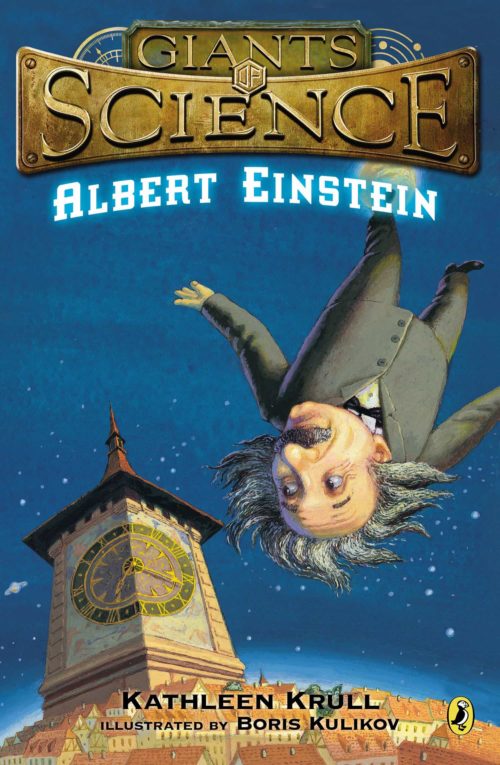
Albert Einstein

By Kathleen Krull, Illustrated by Boris Kulikov

Albert Einstein’s name is a synonym for genius. His wild case of bedhead and his playful sense of humor made him a media superstar, the first, maybe only, scientist-celebrity. He wasn’t much for lab work. In fact, he had a tendency to blow up experiments. What he liked to do was think in “thought experiments.” What was the result of all his thinking? Nothing less than the overturning of Newtonian physics. 8-12 years

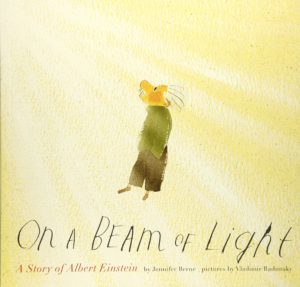
On a Beam of Light: The Story of Albert Einstein

By Jennifer Berne, Illustrated by Vladimir Radunsky

Travel along with Einstein on a journey full of curiosity, laughter, and scientific discovery. See how imagination can make a powerful difference in a life. 6-9 years

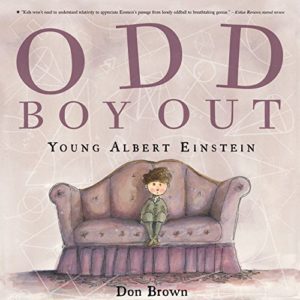
Odd Boy Out: Young Albert Einstein

By Don Brown

When he was born in 1879, Albert was a peculiarly fat baby with an unusually big and misshaped head. When he was a child, he hit his sister, frustrated his teachers, and had few friends. But his childhood also included his brilliant capacity for puzzles and problem solving. He set his mind spinning with ideas. His ideas were destined to change the way we know and understand the world and our place in the universe. 4-7 years

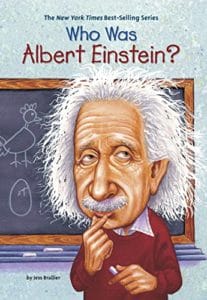
Who Was Albert Einstein?

By Jess Braillier, Illustrated by Robert Andrew Parker

Everyone has heard of Albert Einstein, but what exactly did he do? How much do kids really know about him besides his funny hair and genius label? Here’s the story of his life told in a funny, engaging way that explores the world he lived in and changed. 3-7 years.

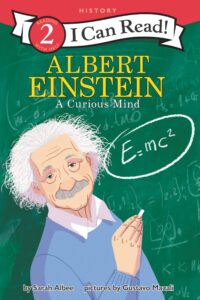
Albert Einstein: A Curious Mind

By Sarah Albee, Illustrated by Gustavo Mazzali

Albert Einstein was a famous scientist who questioned everything—even the laws of physics! Einstein’s innovative thinking paved the way for many important inventions and discoveries that helped shape the world we live in.

Beginning readers will learn about the milestones in Albert Einstein’s life in this Level Two I Can Read. This biography includes a timeline and photos about the life of this inspiring scientist.

This book is a Guided Reading Level Q and a Level Two I Can Read book, geared for kids who read on their own but still need a little help. 4-8 years

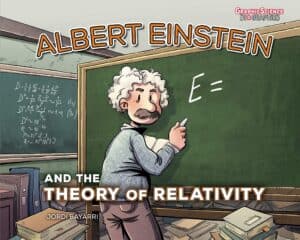
Albert Einstein and the Theory of Relativity

By Jordi Bayarri

Albert Einstein’s restless intelligence drove him to ponder the biggest topics the universe has to offer: light, time, mass, energy, and more. His conclusions changed the way people thought about the laws of physics. But first, he had to pass his university entrance exams. This graphic biography traces Einstein’s path from his home country of Germany to his studies in Switzerland to his time in the United States. It also follows his life as an international scientific celebrity and his refusal to stay silent in the face of anti-Semitism. 10-14 years

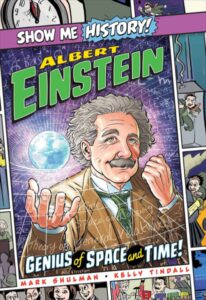
Albert Einstein: Genius of Space and Time

By Mark Shulman, Illustrated by Kelly Tindall

By any measure, Albert Einstein changed the ways we understand—and measure—space and time. At first his ideas were ridiculed, but soon they were idolized. Prior to World War II, Einstein was a celebrated figure in Germany, but when the Nazi Party rose to power in the 1930s, he fled for his life and eventually settled in the United States. This proved to be a crucial decision, as his knowledge of physics helped the United States develop the atomic bomb and win the war. Albert Einstein: Genius of Space and Time! recounts the life of the world’s most famous scientist—from his youth in Germany to his final years in the United States. 8-12 years

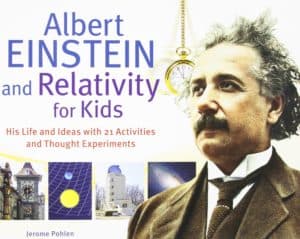
Albert Einstein and Relativity for Kids

By Jerome Pohlen

Albert Einstein made a lasting impact on the world of science with his genius, fascinating life, and unique personality. This book features lots of science activities. Ages 9 and up

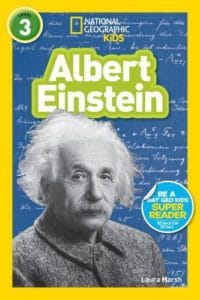
Albert Einstein: National Geographic Readers

By Libby Romero

Explore one of the most recognized scientists in the world with this biography. Kids will learn about his life, achievements, and the challenges he faced along the way. 6-9 years

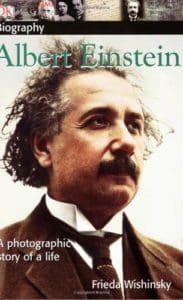
Albert Einstein

By Frieda Wishinsky

This DK biography tackles one of the most colorful figures in science history. Ages 10 and up

The book descriptions used are primarily from the publishers.

If you like this post, then please consider sharing it and leaving a comment below. Thank you! Barbara Lowell, Children’s Author

You may like Books For Kids: Scientists https://barbaralowell.com/books-for-kids-scientists


Harriet Tubman

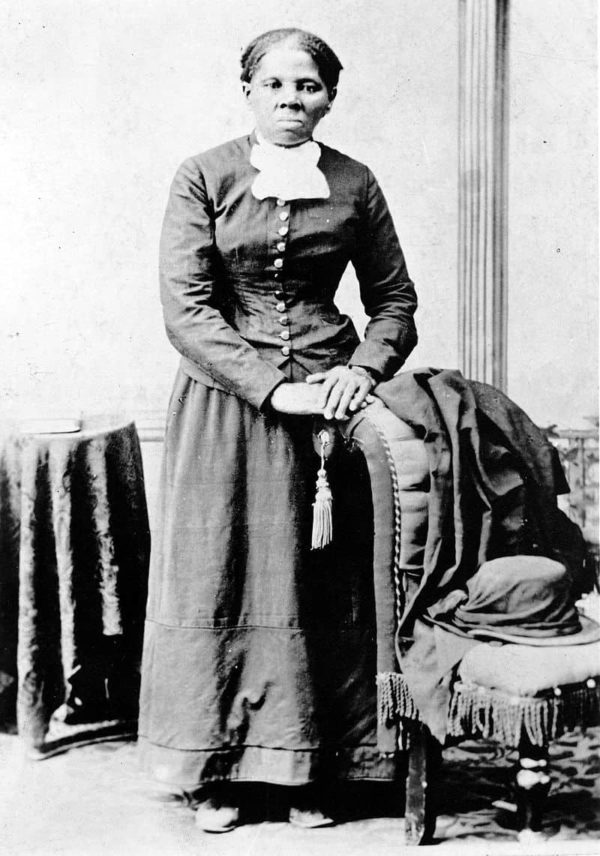
Harriet Tubman is the most famous conductor on the Underground Railroad. Born into slavery about 1822 in Maryland, she escaped from the Brodess Farm in 1849 and traveled undetected to Philadelphia in the free state of Pennsylvania.

One of nine children, her parents named her Araminta and called her Minty. At age five or six she was “hired out” to a nearby family to care for their baby. Minty watched over the baby and if it cried, she was whipped.

As a child she was hit with a metal object meant for another slave. She was severely wounded and suffered from seizures and headaches for the rest of her life. But she recovered from her injury and was able to work on the farm. She plowed, hauled logs, and drove oxen. When Minty married John Tubman around 1844, she changed her name to Harriet, her mother’s name. 
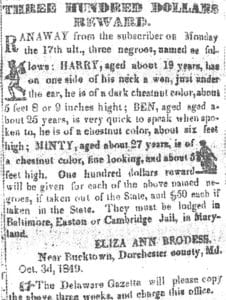
Slave Notice Published by Eliza Brodess

In 1849, Edward Brodess, her owner died. Harriet believed that she and members of her family would be sold by his widow, Eliza. Harriet and her brothers Ben and Harry slipped away. Because they had been “hired out,” Eliza Brodess did not learn of their escape right away. She published a runaway slave notice two weeks later. But Ben and Harry soon changed their minds and returned home. They convinced Harriet to return with them. Shortly after, she escaped again and made her way to freedom by night with the help of abolitionists and freed slaves on the Underground Railroad.

“When I found I had crossed that line, I looked at my hands to see if I was the same person. There was such a glory over everything; the sun came like gold through the trees, and over the fields and I felt like I was in heaven.”
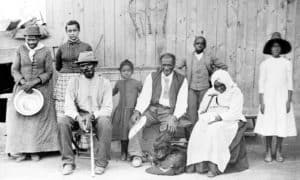
Harriet Tubman (left) and  Former Slaves She Helped Rescue

Once a free woman, Harriet decided to return to Maryland to help family members and other slaves travel to freedom. She returned thirteen times in about ten years and guided 70 slaves north.* Harriet guided the people she helped at night. She liked to travel in the winter months when the days were shorter. And Harriet knew that if she left on a Saturday night, the runaway slave notices wouldn’t be printed in the newspapers until Monday.
Harriet worked as a conductor on the Underground Railroad by leading escaping slaves through a network of safe houses. She earned the nickname “Moses of her people” by guiding slaves safely to northern states and Canada. 

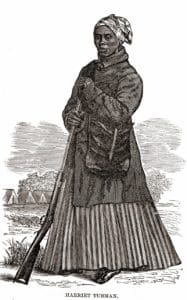
A Woodcut of Harriet Tubman Dressed in Her Civil War Clothing

In 1860, at the start of the Civil War, Harriet became a scout, spy, and a nurse for the Union Army. She helped lead a raid on South Carolina plantations that liberated over 700 slaves.

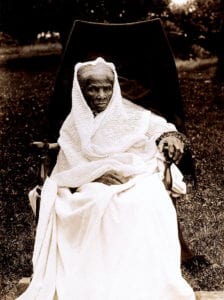
Harriet Tubman in 1910

When the war ended, Harriet moved to Auburn, New York. She cared for her aging parents, whom she had helped to escape north, and other people who needed her help. She later became part of the suffrage movement and spoke publicly for women’s right to vote. Harriet died of pneumonia in 1913, an American hero. 

“I never ran my train off the track and never lost a passenger.” — Harriet Tubman

All photos courtesy of Wikimedia Commons.

*Recent research gives the numbers as thirteen trips, 70 slaves, and disputes earlier figures.

If you like this article, then please consider sharing it and leaving a comment below. Thank you! Barbara Lowell, Children’s Author

You may like:

Books For Kids: Harriet Tubman https://barbaralowell.com/books-for-kids-harriet-tubman

Books For Kids: Underground Railroad https://barbaralowell.com/books-kids-underground-railroad

Books For Kids: Sojourner Truth https://barbaralowell.com/books-for-kids-sojourner-truth

Kids Books: Civil Rights Movement

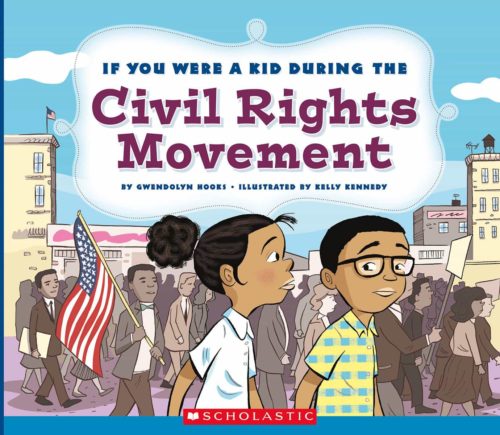
If You Were a Kid in the Civil Rights Movement

By Gwendolyn Hooks, Illustrated by Kelly Kennedy

Joyce Jenkins has recently moved to a new town with her family. She will soon be attending a segregated school for the first time. Connie Underwood is trying to figure out what her twin brothers are planning in secret. The two girls find themselves in the middle of a civil rights demonstration. The fight for equality will the country forever. 

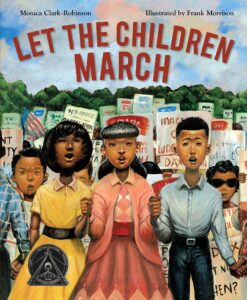
Let the Children March

By Monica Clark-Robinson, Illustrated by Frank Morrison

I couldn’t play on the same playground as the white kids. 
I couldn’t go to their schools.  
I couldn’t drink from their water fountains.  
There were so many things I couldn’t do. 
In 1963 Birmingham, Alabama, thousands of African American children volunteered to march for their civil rights after hearing Dr. Martin Luther King Jr. speak. They protested the laws that kept black people separate from white people. Facing fear, hate, and danger, these children used their voices to change the world. Frank Morrison’s emotive oil-on-canvas paintings bring this historical event to life, while Monica Clark-Robinson’s moving and poetic words document this remarkable time. 

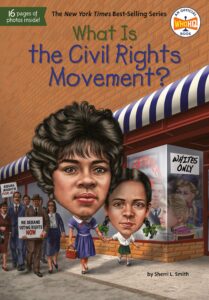
What Is the Civil Rights Movement

By Sherri L. Smith, Illustrated by Tim Foley

Even though slavery had ended in the 1860s, African Americans were still suffering under the weight of segregation a hundred years later. They couldn’t go to the same schools, eat at the same restaurants, or even use the same bathrooms as white people. But by the 1950s, black people refused to remain second-class citizens and were willing to risk their lives to make a change. Author Sherri L. Smith brings to life momentous events through the words and stories of people who were on the front lines of the civil rights movement of the 1950s and 1960s. 8-12 years

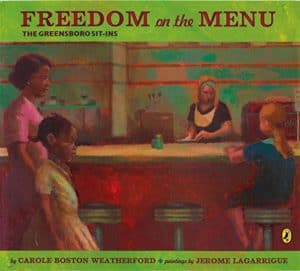
Freedom on the Menu: The Greensboro Sit-Ins

By Carole Boston Weatherford, Illustrated by Jerome Lagarrigue

There were signs all throughout town telling eight-year-old Connie where she could and could not go. But when Connie sees four young men take a stand for equal rights at a Woolworth’s lunch counter in Greensboro, North Carolina, she realizes that things may soon change. This event sparks a movement throughout her town and region. And while Connie is too young to march or give a speech, she helps her brother and sister make signs for the cause. Changes are coming to Connie’s town, but Connie just wants to be able to sit at the lunch counter and eat a banana split like everyone else.

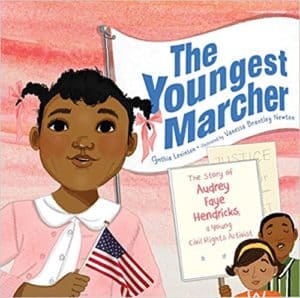
The Youngest Marcher: The Story of Audrey Faye Hendricks,

A Young Civil Rights Activist

By Cynthia Levinson, Illustrated by Vanessa Brantley-Newton

Nine-year-old Audrey Faye Hendricks intended to go places and do things like anybody else. So when she heard grown-ups talk about wiping out Birmingham’s segregation laws, she spoke up. As she listened to the preacher’s words, smooth as glass, she sat up tall. And when she heard the plan: picket those white stores, march to protest those unfair laws, and fill the jails — she stepped right up and said, “I’ll do it. Audrey Faye Hendricks was confident and bold and brave as can be. Hers is the remarkable and inspiring story of one child’s role in the Civil Rights Movement. 

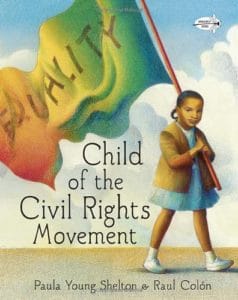
Child of the Civil Rights Movement

By Paula Young Shelton, Illustrated by Raul Colon

Paula Young Shelton, daughter of Civil Rights activist, Andrew Young, brings a child’s unique perspective to an important chapter in America’s history. Paula grew up in the deep south, in a world where whites had and blacks did not. With an activist father and a community of leaders surrounding her, including Uncle Martin (Dr. Martin Luther King, Jr.,) Paula watched and listened to the struggles. She eventually joined with her family, and thousands of others, in the historic march from Selma to Montgomery.

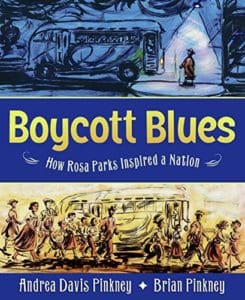
Boycott Blues: How Rosa Parks Inspired a Nation

By Andrea Davis Pinkney, Illustrated by Brian Pinkney

Rosa Parks took a stand by keeping her seat on the bus. When she was arrested, her supporters protested by refusing to ride. Soon a community of thousands came together to help each other. Some started taxi services, some rode bikes, but many walked. After 382 days, they walked Jim Crow laws right out of town. Boycott Blues presents a poignant, blues-infused tribute to the men and women of the Montgomery bus boycott who refused to give up until they got justice.

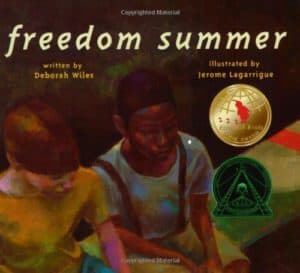
Freedom Summer

By Deborah Wiles, Illustrated by Jerome Lagarrigue

Joe and John Henry are a lot alike. They both like shooting marbles, they both want to be firemen, and they both love to swim. But there’s one important way they’re different, Joe is white and John Henry is black. In the South in 1964, John Henry isn’t allowed to do everything his best friend is. Then a law is passed that forbids segregation. The town pool opens to everyone. Joe and John Henry are so excited they race each other to the pool, only to discover that it takes more than a new law to change people’s hearts.

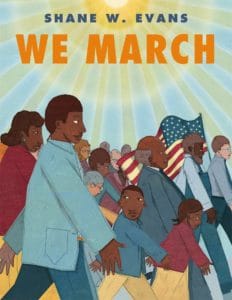
We March

By Shane W. Evans

On August 26, 1963, a remarkable event took place. More than 250,000 people gathered in our nation’s capital to participate in the March on Washington for Jobs and Freedom. The march began at the Washington Memorial and ended with a rally at the Lincoln Memorial, where Dr. Martin Luther King, Jr. delivered his historic “I Have a Dream” speech. The thrill of this day is brought to life in We March, even for the youngest reader. 

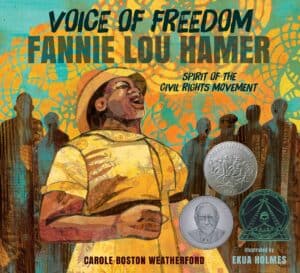
Voice of Freedom: Fannie Lou Hamer

By Carole Boston Weatherford, Illustrated by Ekua Holmes

“I am sick and tired of being sick and tired.”

Despite fierce prejudice and abuse, even being beaten to within an inch of her life, Fannie Lou Hamer was a champion of civil rights from the 1950s until her death in 1977. Integral to the Freedom Summer of 1964, Ms. Hamer gave a speech at the Democratic National Convention that, despite President Johnson’s interference, aired on national TV news and spurred the nation to support the Freedom Democrats. Featuring vibrant mixed-media art full of intricate detail, Voice of Freedom celebrates Fannie Lou Hamer’s life and legacy with a message of hope, determination, and strength. 10-13 years

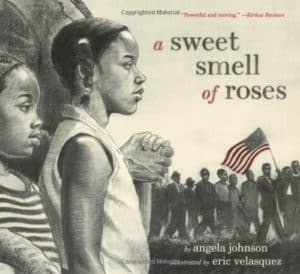
A Sweet Smell of Roses

By Angela Johnson, Illustrated by Eric Velazquez

There’s a sweet smell in the air as two young girls sneak out of their house, down the street, and across town to where men and women are gathered, ready to march for freedom and justice. A Sweet Smell of Roses is inspired by countless children and young adults who took a stand and participated in the Civil Rights Movement. 

The book descriptions used are primarily the publishers.

If you like this post, then please consider sharing it and leaving a comment below. Thank you! Barbara Lowell, Children’s Author

You may like: Kids Books: Martin Luther King, Jr. https://barbaralowell.com/kids-books-martin-luther-king-jr

Mahalia Jackson Her Words Changed History  https://barbaralowell.com/mahalia-jacksons-words


Thomas Edison Invented…

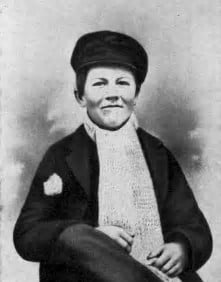
Thomas Edison grew up at a time when children went to work to help support their families. At age twelve or thirteen, he sold newspapers on the train that ran from his hometown, Port Huron, Michigan, to Detroit.

In his free time, Thomas liked to read all about science and technology. He also liked to experiment with chemicals. He set up a laboratory in his basement. And he even conducted experiments in the baggage car of the train he worked on.

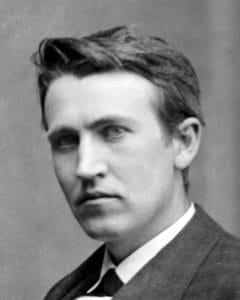
Young Thomas Edison (Wikimedia Commons)

At age sixteen, Thomas became a telegraph operator for the railroad. But he had to leave his job after a train accident was blamed on him. He then worked for the Associated Press at night. This job allowed him to read and work on experiments during the day.

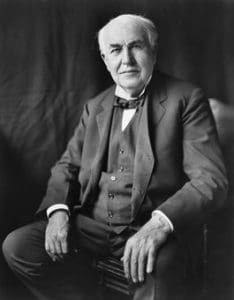
Thomas Edison (Wikimedia Commons)

His first invention was an electric vote recorder. The recorder could be used by members of legislatures to count their votes on bills right away. But it was a failure. Thomas discovered that politicians did not want a fast way to count their votes.

Thomas’s first successful invention was a stock ticker that improved on earlier ones. His stock ticker let investors know quickly what was happening in the stock market.

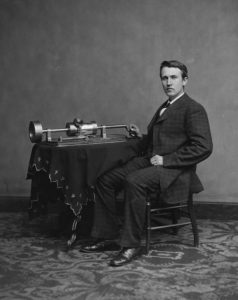
Thomas Edison and his phonograph (Pixabay)

Thomas Edison’s first big invention was the phonograph. It recorded and produced sound that people could hear clearly. This invention made him famous all over the world. He became known as “The Wizard of Menlo Park.” Menlo Park was his research laboratory complex in New Jersey.

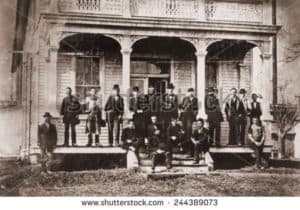
Thomas Edison and engineers at Menlo Park (Shutterstock)

Now it was time for his greatest invention, the incandescent light bulb. Inventors had tried for years to come up with an electric light bulb that would replace gaslight. But no one had found a practical way to do that.

First, Thomas set up the Edison Electric Light Company. Then he worked for years trying to perfect a light bulb. He failed many times until he tried a platinum filament. The light bulb burned for 13 1/2 hours. But Thomas wanted a bulb that would burn much longer and would be cheaper to make.

Edison light bulb (Shutterstock)

Thomas had been fishing with a bamboo pole made from bamboo threads. He decided to try a carbonized bamboo filament. And eureka, his light bulb lasted for over 1,200 hours. It was affordable too. Thomas demonstrated his light bulb by lighting up his Menlo Park laboratory complex.

Thomas Edison (Pixabay)

Thomas wasn’t satisfied just inventing a practical light bulb. He wanted to light up everyone’s home, business, and factory. He started the Edison Illuminating Company. Thomas’s first power station went into operation in Manhattan. It lit up a one-mile square area. It was only a matter of time until electric light lit up the world.

His other inventions include a motion picture camera, and a Kinetoscope to project the images on, and the first alkaline battery for electric cars. It was the forerunner of the alkaline batteries we use today. 

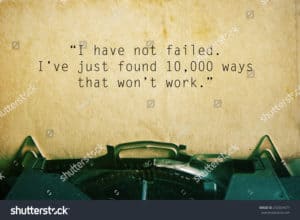
A quote by Thomas Edison (Shutterstock)

To learn more about Thomas Edison and his inventions visit: https://www.nps.gov/edis/learn/historyculture/edison-biography.htm

If you like this post, then please consider sharing it and leaving a comment below. Thank you! Barbara Lowell, Children’s Author

You may like:

Books For Kids: Thomas Edison https://barbaralowell.com/books-for-kids-thomas-edison

Benjamin Franklin Invented Swim Fins https://barbaralowell.com/ben-franklin-invented-swim-fins

Leonardo Da Vinci Invented… https://barbaralowell.com/leonardo-da-vinci-invented

Ada Lovelace First Computer Programmer https://barbaralowell.com/ada-lovelace-computer


Books For Kids: Ben Franklin

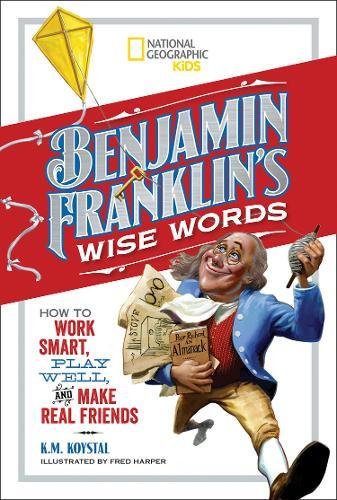
Benjamin Franklin’s Wise Words

by K.M. Koystal and Benjamin Franklin, Illustrated by Fred Harper

Discover history through the eyes of one of the smartest, funniest, and coolest figures from America’s past. Ben gives sage advice on everything from good citizenship, manners,  friendship, and being happy. 

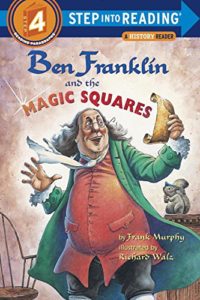
Ben Franklin & the Magic Squares

By Frank Murphy, Illustrated by Richard Walz

A funny, entertaining introduction to Ben Franklin and his many inventions, including the story of how he created the “magic square.” A magic square is a box of nine numbers. They are arranged so that any line of three adds up to the same number, even on the diagonal. 

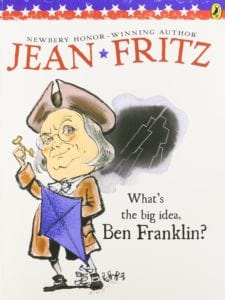
What’s the Big Idea Ben Franklin

By Jean Fritz, Illustrated by Margaret Tomes

A fun historic tale by Newbery Honor-winning author, Jean Fritz! No matter how busy he was, Ben Franklin always found time to try out new ideas. A man of many talents, he was an ambassador, a printer, an almanac maker, a politician, and even a vegetarian (for a time.)

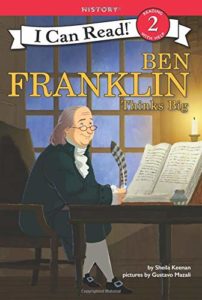
Ben Franklin Thinks Big

By Shelia Keenan, Illustrated by Gustavo Mazali

Ben Franklin was a famous inventor, statesman, and writer who helped the thirteen colonies become the United States. From inventing the lightning rod to helping write the Declaration of Independence, his big ideas had a lasting impact on American history.

Beginning readers will learn about the milestones in Ben Franklin’s life in this Level Two I Can Read biography. This biography includes bonus materials, complete with a timeline and historical illustrations, including Franklin’s electrical machine invention and his leaf print money that couldn’t be counterfeited. 4-8 years

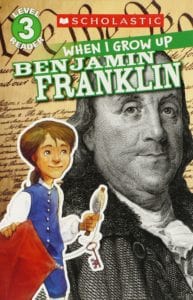
When I Grow Up: Benjamin Franklin

By Annmarie Anderson, Illustrated by Gerald Kelley

Benjamin Franklin is one of America’s most beloved Founding Fathers and a man of many talents. He is most well-known for discovering electricity. But he was also an author, and editor, a printer, and a diplomat. And he invented many things we still use today. This book takes the reader on an exciting journey from Ben’s childhood to his adulthood as a famous American.

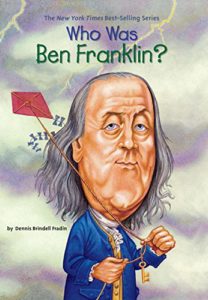
Who Was Ben Franklin

By Dennis Brindell Fradin, Illustrated by John O’Brien

Ben Franklin was the scientist who, with the help of a kite, discovered that lightning is electricity. He was also a statesman, an inventor, a printer, and an an author. He was a man of such amazingly varied talents that some people claimed he had magical powers. 

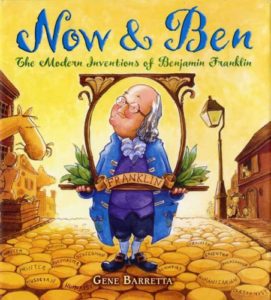
Now and Ben: The Modern Inventions of Benjamin Franklin

By Gene Barretta

What would you do if you lived in a community without a library, hospital, post office, or fire department? If you were Ben Franklin, you’d set these up yourself. Franklin also designed the lightning rod. He suggested the idea of daylight savings time. And he invented bifocals. All were inspired by his common sense and intelligence. 

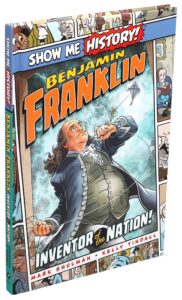
Benjamin Franklin: Inventor of the Nation

By Mark Shulman, Illustrated by Kelly Tindall

Benjamin Franklin has been called one of the most accomplished and influential Americans in history, and his role in shaping the United States has had a lasting impact that is still felt today. From his birth in Boston in 1706 to his days as a printer, inventor, and politician.

Benjamin Franklin: Inventor of the Nation! tells the story of “the First American” in an accessible graphic novel format. Franklin’s research into topics as varied as electricity, meteorology, demography, and oceanography were as wide-ranging and important as his travels, which took him across the globe as a diplomat for the newly founded United States toward the end of the 18th century.

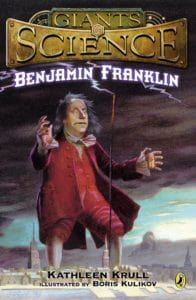
Benjamin Franklin (Giants of Science)

By Kathleen Krull, Illustrated by Boris Kulikov

Benjamin Franklin was a famous inventor and multitasker. He’s best remembered as one of America’s Founding Fathers. But he was also a scientist. His experiments led to important discoveries about the nature of electricity. He famously demonstrated that electricity and lightning are one in the same. 

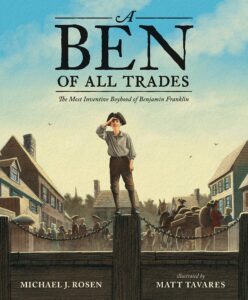
A Ben of All Trades: The Most Inventive Boyhood of Benjamin Franklin

By Michael J. Rosen, Illustrated by Matt Tavares

Young Benjamin Franklin wants to be a sailor, but his father won’t hear of it. The other trades he tries — candle maker, joiner, boot closer, turner — bore him through and through. Curious and inventive, Ben prefers to read, swim, fly his kite, and fly his kite while swimming. But each time he fails to find a profession, he takes some important bit of knowledge with him.

That tendency is exactly what leads him to become the astonishingly versatile genius we remember today. Inspired by The Autobiography of Benjamin Franklin, Michael J. Rosen’s tale captures Ben’s spirit in playful language, while illustrations by Matt Tavares follow Ben from the workbench to the water in vivid detail. 

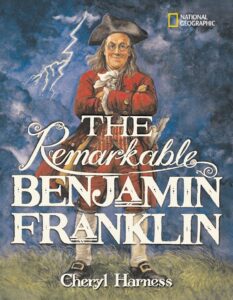
The Remarkable Benjamin Franklin

By Cheryl Harness

No one could have thought up a more amazing character than the living, breathing Benjamin Franklin. He was everything from a “soapmaker, candle dipper, and printer” to a “postmaster, political activist, community reformer, revolutionary, statesman, international diplomat, and first great citizen of a nation which he, as much or more than anyone, helped to create.” 

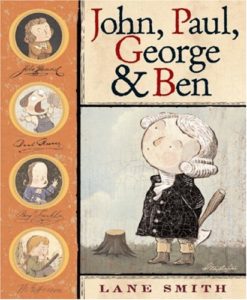
John, Paul, George & Ben

By Lane Smith

Once there were four lads…John [Hancock], Paul [Revere], George [Washington], and Ben [Franklin]. Oh yes, there was also Tom [Jefferson], but he was annoyingly independent and hardly ever around. These lads were always getting into trouble for one reason or another. In other words, they took a few…liberties. And to be honest, they were not always appreciated. This is the story of five little lads before they became five really big Founding Fathers.

The book descriptions used are primarily from the publishers.

If you like this post, then please consider sharing it and leaving a comment below. Thank you! Barbara Lowell, Children’s Author

You may like: Ben Franklin Invented Swim Fins  https://barbaralowell.com/ben-franklin-invented-swim-fins

Ben Franklin Runs Away

https://barbaralowell.com/ben-franklin-runs-away


Kids Books: Underground Railroad

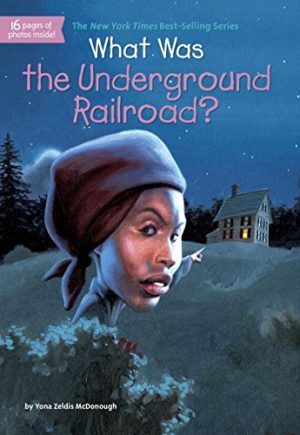
What Was the Underground Railroad?

by Yona Zeldis McDonough, Illustrated by Lauren Mortimer

No one knows where the term Underground Railroad came from–there were no trains or tracks, only “conductors” who helped escaping slaves to freedom. Including real stories about “passengers” on the “Railroad,” this book chronicles slaves’ close calls with bounty hunters, exhausting struggles on the road, and what they sacrificed for freedom. 8-12 years

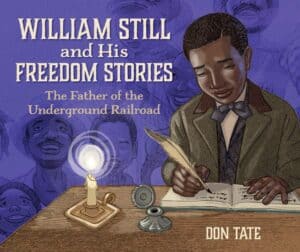
William Still and His Freedom Stories: The Father of the Underground Railroad

By Don Tate

William Still’s parents escaped slavery but had to leave two of their children behind, a tragedy that haunted the family. As a young man, William went to work for the Pennsylvania Anti-Slavery Society, where he raised money, planned rescues, and helped freedom seekers who had traveled north. And then one day, a strangely familiar man came into William’s office, searching for information about his long-lost family. Could it be?

Motivated by his own family’s experience, William began collecting the stories of thousands of other freedom seekers. As a result, he was able to reunite other families and build a remarkable source of information, including encounters with Harriet Tubman, Henry “Box” Brown, and William and Ellen Craft. 6-9 years

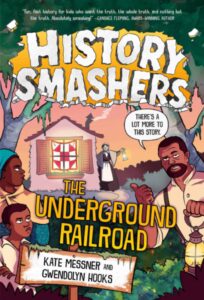
History Smashers: The Underground Railroad

By Kate Messner and Gwendolyn Hooks, Illustrated by Damon Smyth

Myths! Lies! Secrets! Uncover the hidden truth about the Underground Railroad and Black Americans’ struggle for freedom. Before the Civil War, there was a crack team of abolitionists who used quilts and signal lanterns to guide enslaved people to freedom. RIGHT? WRONG! The truth is, the Underground Railroad wasn’t very organized, and most freedom seekers were on their own. With a mix of sidebars, illustrations, photos, and graphic panels, this book delivers the whole truth about the Underground Railroad. 8-12 years

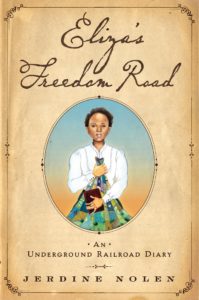
Eliza’s Freedom Road: An Underground Railroad Diary

By Jerdine Nolan, Illustrated by Shadra Strickland

It is 1852 in Alexandria, Virginia. Eliza’s mother has been sent away. It is Abbey, the cook, who looks after Eliza, when Eliza isn’t taking care of the Mistress. Eliza has the quilt her mother left her. And the memory of the stories she told her to keep her close. The Mistress’s health begins to fail. Eliza overhears the Master talk of her being traded. She takes to the night.

She follows the path and the words of the farmhand Old Joe, “ … travel the night … sleep the day. Go East. Your back to the set of the sun until you come to the safe house where the candlelight lights the window.” All the while, Eliza recites the stories her mother taught her along her Freedom Road from Maryland to St. Catherine’s, Canada. 8-12 years

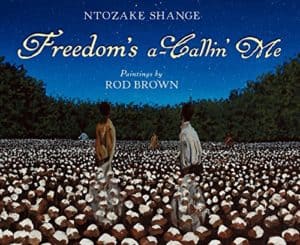
Freedom’s a-Callin’ Me

By Ntozake Shange, Illustrated by Rod Brown

Fleeing on the Underground Railroad meant walking long distances. Swimming across streams. Hiding in abandoned shanties, swamps, and ditches. And always on the run from slave trackers and their dogs. 

The Underground Railroad operated on secrecy and trust. But who could be trusted? There were free black and white men and women helping. They risked their lives too. Because freedom was worth the risk. 6-10 years

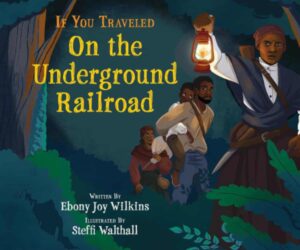
If You Traveled on the Underground Railroad

By Ebony Joy Wilkins, Illustrated by Steffi Walthall

What if you lived in a different time and place? What would you wear? What would you eat? How would your daily life be different? How did the Underground Railroad get its name? Why is it called a railroad? How did people find it? Who operated it? Ebony Joy Wilkins answers all these questions and more in this guide to the Underground Railroad. 7-10 years

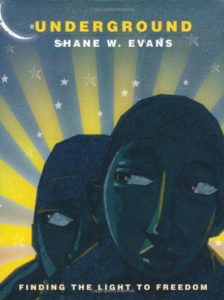
Underground

By Shane W. Evans

A family silently crawls along the ground. They run barefoot through unlit woods, sleep beneath bushes, take shelter in a kind stranger’s home. Where are they heading? They are heading for freedom by way of the Underground Railroad. 4-8 years

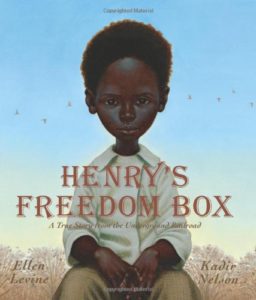
Henry’s Freedom Box: A True Story from the Underground Railroad

By Ellen Levine, Illustrated by Kadir Nelson

Henry Brown doesn’t know how old he is. Nobody keeps records of slaves’ birthdays. All the time he dreams about freedom. But that dream seems farther away than ever. He is torn from his family and put to work in a warehouse. 

Henry grows up and marries. But he is again devastated when his family is sold at the slave market. Then one day, as he lifts a crate at the warehouse, he knows what he must do. He will mail himself to the North in a crate. After a long journey, Henry finally has a birthday. It’s his first day of freedom. 5-9 years

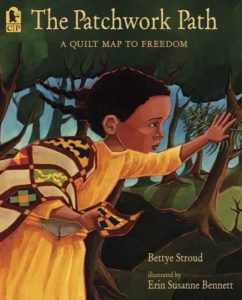
The Patchwork Path: A Quilt Map to Freedom

By Bettye Stroud, Illustrated by Erin Susanne Bennett 

Hannah’s papa has decided to make the run for freedom. Her patchwork quilt is not just a precious memento of Mama. It’s a series of hidden clues that will guide them along the Underground Railroad to Canada. 5-8 years

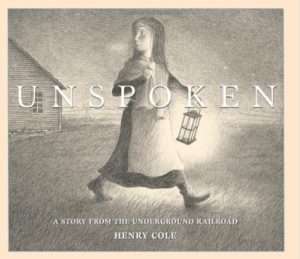
Unspoken

by Henry Cole

A farm girl discovers a runaway slave hiding in the barn. She is at once startled and frightened. But the stranger’s fearful eyes weigh upon her conscience. She must make a difficult choice. Will she have the courage to help him? 8-11 years

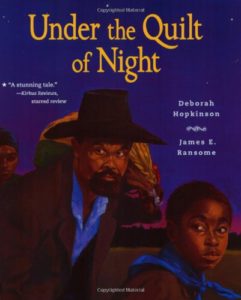
Under the Quilt of Night

by Deborah Hopkinson, Illustrated by James E. Ransome

A runaway slave girl spies a quilt hanging outside a house. The quilt’s center is a striking deep blue. This is a sign that the people inside will help her. But can she navigate the Underground Railroad? Can she lead her family to freedom? 5-10 years

The books descriptions used are primarily from the publishers.

If you like this post, then please consider sharing it and leaving a comment below. Thank you! Barbara Lowell, Children’s Author

You may like: Harriet Tubman https://barbaralowell.com/harriet-tubman

Books For Kids: Harriet Tubman https://barbaralowell.com/books-for-kids-harriet-tubman

Books For Kids: Sojourner Truth https://barbaralowell.com/books-for-kids-sojourner-truth

Underground Railroad https://www.ducksters.com/history/civil_war/underground_railroad.php

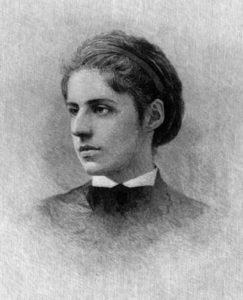
Emma Lazarus

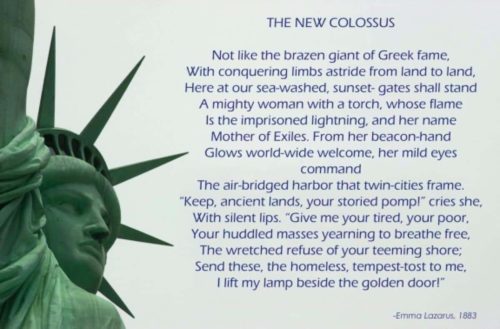
“Give me your tired, your poor, your huddled masses yearning to breathe free…I lift my lamp beside the golden door.” 

Poet Emma Lazarus wrote these famous words as part of a sonnet for a fundraising auction.

As a girl, Emma wrote poetry and translated poems from German and French into English. Her father, recognizing her talent, published her first book of poems, Poems and translations by Emma Lazarus, written between the ages of Fourteen and Seventeen.

Emma met and then wrote to one of America’s best known poets, Ralph Waldo Emerson, when she was nineteen. She and Emerson worked together as student and mentor. Emma continued to write and publish books of poetry.

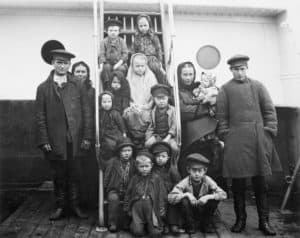
Emma also dedicated herself to helping Russian Jewish refugees escaping persecution in their homeland. The refugees lived in poor conditions on Ward’s Island in New York Harbor. Emma brought them clothing and food, set up English classes, and a trade school. She wrote about their plight hoping they would be accepted into American society.

In 1883, a committee invited Emma to participate in a fundraising campaign to provide a pedestal for the Statue of Liberty. The committee asked her to write a sonnet to be auctioned to help raise money for the pedestal.

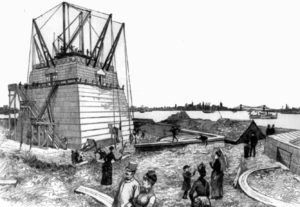
The statue, a gift from France, sat disassembled in crates on Bedloe’s Island in New York Harbor. The people of France paid for the statue. Now Americans raised money to pay for the pedestal to support it. But an economic depression made fundraising difficult.

At first, Emma declined the invitation to write a sonnet. Not only was the auction a week away, but as she told a pedestal committee member, Ms. Harrison, “A poem written to order would be flat.” Ms. Harrison asked Emma to think about the Russian Jewish refugees she had been helping. They could inspire her poem.

Emma thought it over. It seemed to her that the statue would light the way for immigrants entering New York Harbor. The Statue of Liberty would welcome them to their new home. She decided to write the poem and called it “The New Colossus.”

Joseph Pulitzer, the publisher of The New York World, asked people around the country to contribute money to build the pedestal. To help with the cause, he published Emma’s poem in his newspaper.

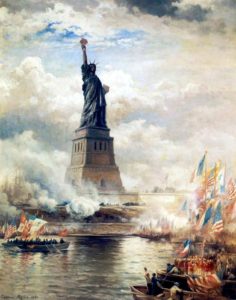
Pulitzer raised over $100,000. Most of the contributions were less than $1.00. The pedestal was built and the statue reassembled. President Grover Cleveland dedicated the Statue of Liberty on October 28, 1886.

In 1903, words from Emma’s “The New Colossus” were inscribed on a plague placed in the Statue of Liberty’s pedestal. Unfortunately, Emma had died in 1887. She never knew that her words, inspired by refugees, welcomed generations of new immigrants seeking freedom in America.

“Give me your tired, your poor, your huddled masses yearning to breathe free…”

If you like this post, then please consider sharing it and leaving a comment below. Thank you! Barbara Lowell, Children’s Author

You may like: Books For Kids Statue of Liberty https://barbaralowell.com/books-for-kids-statue-of-liberty

To Learn more: https://www.nps.gov/stli/learn/historyculture/emma-lazarus.htm

Books For Kids:

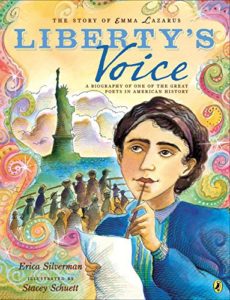
The Story of Emma Lazarus: Liberty’s Voice

By Erica Silverman, Illustrated by Stacey Schuett

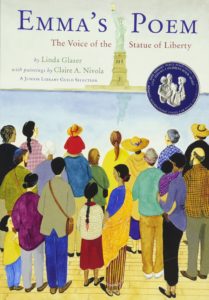
Emma’s Poem: The Voice of the Statue of Liberty

By Linda Glaser, Illustrated by Claire A. Nivola

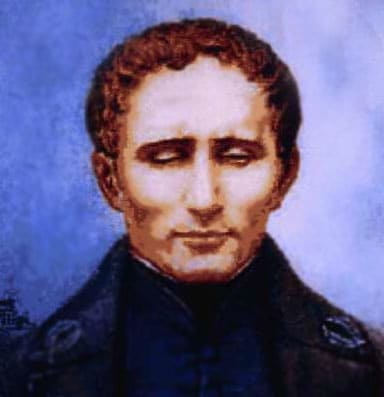
Louis Braille — The Boy Who Invented the Braille Alphabet

Louis Braille lived in the French village of Coupvray. Born in 1809, he was the fourth child of a harness maker and his wife. Louis was a bright and curious child. He especially enjoyed watching his father at work.

One day, three-year-old Louis decided to try out his father’s awl, a very sharp tool. Unfortunately, he injured his eye. It became infected and when Louis touched the uninjured eye, the infection spread, blinding him.

Louis Braille House, Coupvray, France

Louis’s family and a village priest helped him. His father made a cane so that Louis could walk without assistance. His sisters made an alphabet from straw so that he could learn letters. And the priest read to Louis and taught him to listen to the sounds of birds to recognize them.

Louis later went to school with sighted children and listened to and remembered the lessons. But for Louis, that wasn’t enough. He wanted to read books.

When he was ten-years-old, he traveled to Paris to attend the Royal Institution for Blind Youth. The school’s founder had created books with raised letters. But the letters were enormous with only a few sentences or less on a page. The books were not practical.

Then a French army captain named Charles Barbier invented a system of sending messages to soldiers on the field. His system used raised dots so that the soldiers could read the messages without light and not give away their location to the enemy.

The army seemed unimpressed, so Barbier sent his system to the Royal Institution for Blind Youth. Louis and the other students recognized right away that this system was not practical. The dots represented sounds not letters. They were difficult for the students to read.

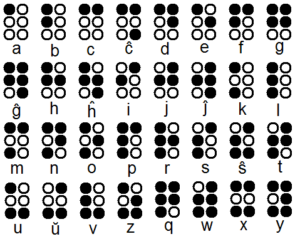
Louis Braille’s Six-Dot Braille System

Louis Braille decided to adapt Barbier’s system and make it practical. He worked for three years to perfect it. By the age of fifteen, he had developed the six-dot Braille System we know today. Each letter of the alphabet uses a different pattern of raised dots. Louis’s system is used in every country in the world.

Braille

If you like this post, then please consider sharing it and leaving a comment below. Thank you! Barbara Lowell, Children’s Author

You may like: Books For Kids Helen Keller https://barbaralowell.com/books-for-kids-helen-keller

Books for Kids:

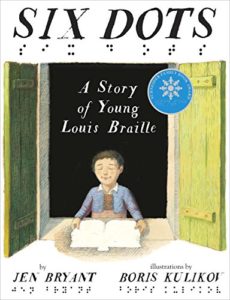
Six Dots: A Story of Young Louis Braille

By Jen Bryant, Illustrated by Boris Kulikov

Who Was Louis Braille?

By Margaret Frith

Illustrated by Robert Squier and Scott Anderson

Out of Darkness: The Story of Louis Braille

By Russell Freedman, Illustrated by Kate Kiesler

To Learn More Visit: http://nbp.org/ic/nbp/braille/whoislouis.html